
Does My House Need a Rewire?
Check the Warning Signs Below
Most homeowners don’t wake up one morning and decide they need a rewire. It usually starts with a niggling problem: lights flickering, a socket that doesn’t work properly, an EICR that’s come back with issues, or a surveyor’s report on a house you’re buying.
The warning signs below will help you work out whether your home’s wiring might need attention. Check each one. If any apply, it’s worth getting a professional assessment.
1. Your Fuseboard Still Has Rewirable Fuses
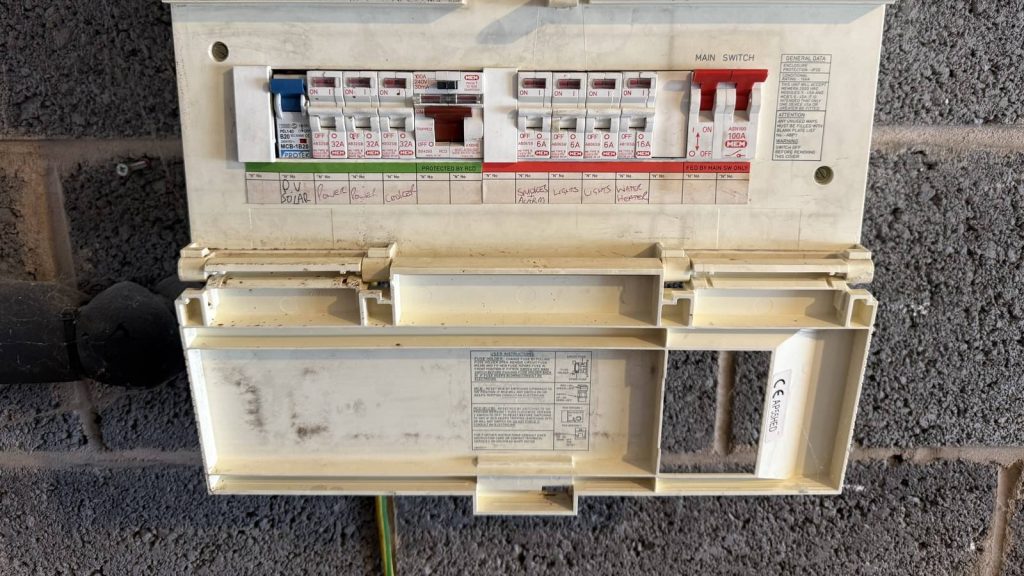
Open the cupboard under the stairs (or wherever your fuseboard is) and take a look. If you see a row of white ceramic fuse holders with exposed fuse wire, your consumer unit predates modern safety standards.
Rewirable fuse boards don’t have RCD protection, the safety device that cuts the power in milliseconds if there’s a fault. Without it, an electrical fault could cause a fire or a fatal electric shock before the fuse blows.
An old fuseboard doesn’t automatically mean the whole house needs rewiring, but it does mean the wiring is likely of a similar age and should be assessed.
Send us a photo and we’ll tell you what you’re looking at, free, no obligation.
2. You Can See Old-Style Cables
Modern electrical cable has a grey or white PVC outer sheath. If you can see any of the following in your loft, under floors, or behind sockets, the wiring is old and may need replacing:
Black rubber-insulated cables: Common in properties wired before the 1960s. The rubber insulation becomes brittle with age and can crack, exposing live conductors.
Lead-sheathed cables: Found in some pre-war properties. The lead outer sheath was used before PVC was available.
Fabric-covered cables: Sometimes called VIR (vulcanised India rubber). The fabric braiding and rubber insulation deteriorate significantly over time.
If you spot any of these, don’t touch them, and don’t assume they’re safe just because they’re still working. Deteriorated insulation is a fire risk even if the circuit appears to function normally.
Send us a photo and we’ll confirm what type of wiring you have and whether it needs replacing.
3. Sockets or Switches Feel Warm, Crackle, or Smell Burnt
A socket that feels warm to the touch, makes a crackling or buzzing sound, or has brown scorch marks around it is a serious warning sign. This usually indicates a loose connection, damaged wiring, or an overloaded circuit.
Warm sockets are not normal. A properly wired socket should feel the same temperature as the wall around it, even when something is plugged in and drawing power.
If you notice a burning smell from any socket or switch, stop using it immediately and get it checked. This is one situation where you should not wait.
This needs checking urgently. Message us now and we’ll prioritise getting someone out to you.
4. Your Electrics Trip Frequently
Occasional tripping can happen for simple reasons, a faulty appliance, for example. But if your electrics trip regularly, especially if the whole board trips rather than a single circuit, it could indicate wiring problems.
Common causes of frequent tripping that point to wiring issues include deteriorated cable insulation allowing current to leak to earth, connections that have loosened over time, and circuits that have been overloaded by adding more outlets than the wiring was designed to handle.
We’ve written a detailed guide on why electrics keep tripping that covers the common causes and what to do about each one.
Tell us what’s happening and we’ll help you work out whether it’s a simple fix or a sign of something bigger.
5. Your EICR Has Flagged Problems
An Electrical Installation Condition Report (EICR) is a formal inspection and test of your wiring. If you’ve had one carried out, perhaps because you’re a landlord, buying a property, or your insurer requested it, and it’s come back with C2 (potentially dangerous) or C3 (improvement recommended) codes, your wiring may need partial or full replacement.
Common EICR findings that can lead to a rewire recommendation include low insulation resistance readings across multiple circuits, absence of RCD protection, inadequate earthing arrangements, and evidence of deterioration in older cable types.
If your EICR has flagged issues and you’re not sure what the codes mean or what needs doing, we’re happy to look at the report and explain it in plain English.
Send us a photo of the report and we’ll explain what the codes mean and what work is actually needed.
6. You’re Buying an Older Property
If you’re purchasing a home, particularly one built before the 1980s, and the surveyor has raised concerns about the electrics, or you can see the fuseboard looks dated, it’s worth getting the wiring assessed before you complete.
Many buyers in Rotherham and South Yorkshire discover wiring issues after moving in, when they could have factored the cost into their negotiations or had the seller address it.
A pre-purchase electrical assessment gives you a clear picture of what you’re taking on. If a rewire is needed, you can negotiate the price down or ask the seller to have it done before completion.
We can carry out a pre-purchase electrical assessment and give you a clear report before you commit.
7. The Wiring Hasn’t Been Touched in 25+ Years
Even if nothing seems obviously wrong, electrical installations don’t last forever. The IET (Institution of Engineering and Technology) recommends that domestic wiring is inspected and tested at least every ten years, and more frequently in rental properties.
If your property was last rewired, or has never been rewired, more than 25 years ago, the cables, connections, and protective devices are approaching the end of their expected service life. An inspection now can identify developing problems before they become dangerous.
What to Do Next
If any of the warning signs above apply to your home, the next step is a professional assessment. We’ll inspect the visible wiring, test the circuits where needed, and give you an honest recommendation: whether that’s a full rewire, a partial rewire, or something simpler.
There’s no charge for the initial assessment and absolutely no obligation. We’d rather tell you your wiring is fine and leave with nothing to do than talk you into work you don’t need.
NAPIT registered: all work certified and notified to Building Control
320+ five-star Google reviews: trusted by homeowners across South Yorkshire
Six-year insurance-backed guarantee: on all rewiring work
Free, no-obligation assessments: honest advice you can trust
Message us with your postcode and a brief description of what you’ve noticed. We’ll get back to you quickly to arrange a visit.
Why Choose MP Electrical?
Had work done by MP Electrical?
⭐ Leave Us a Google ReviewAreas We Cover
Page last updated: 12 September 2026