
Plug In Solar Panels: What Rotherham Homeowners Need to Know
Since plug in solar went on sale at the end of August, there’s one question on a lot of people’s lips. “Can I just buy one of those solar panels from B&Q and plug it in?”
Yes, you can now. But there’s more to it than the adverts suggest, and getting your electrics checked first could save you a lot of bother.
I’ve spent a few evenings going through the new rules, the product specification and the safety advice from the industry bodies. This is how it plays out in a normal Rotherham house.
Quick answer
Since 27 August 2026, households in England, Scotland and Wales have been able to legally buy and use plug in solar panels. Northern Ireland isn’t covered yet. A kit can feed up to 800W into your home through a normal 13A plug, and it’s one kit per home for now. The government says you could save up to £110 a year. Before you plug one in, get your consumer unit and sockets checked, especially if you’ve got an old fuse box or older RCDs.
What is a plug in solar panel?
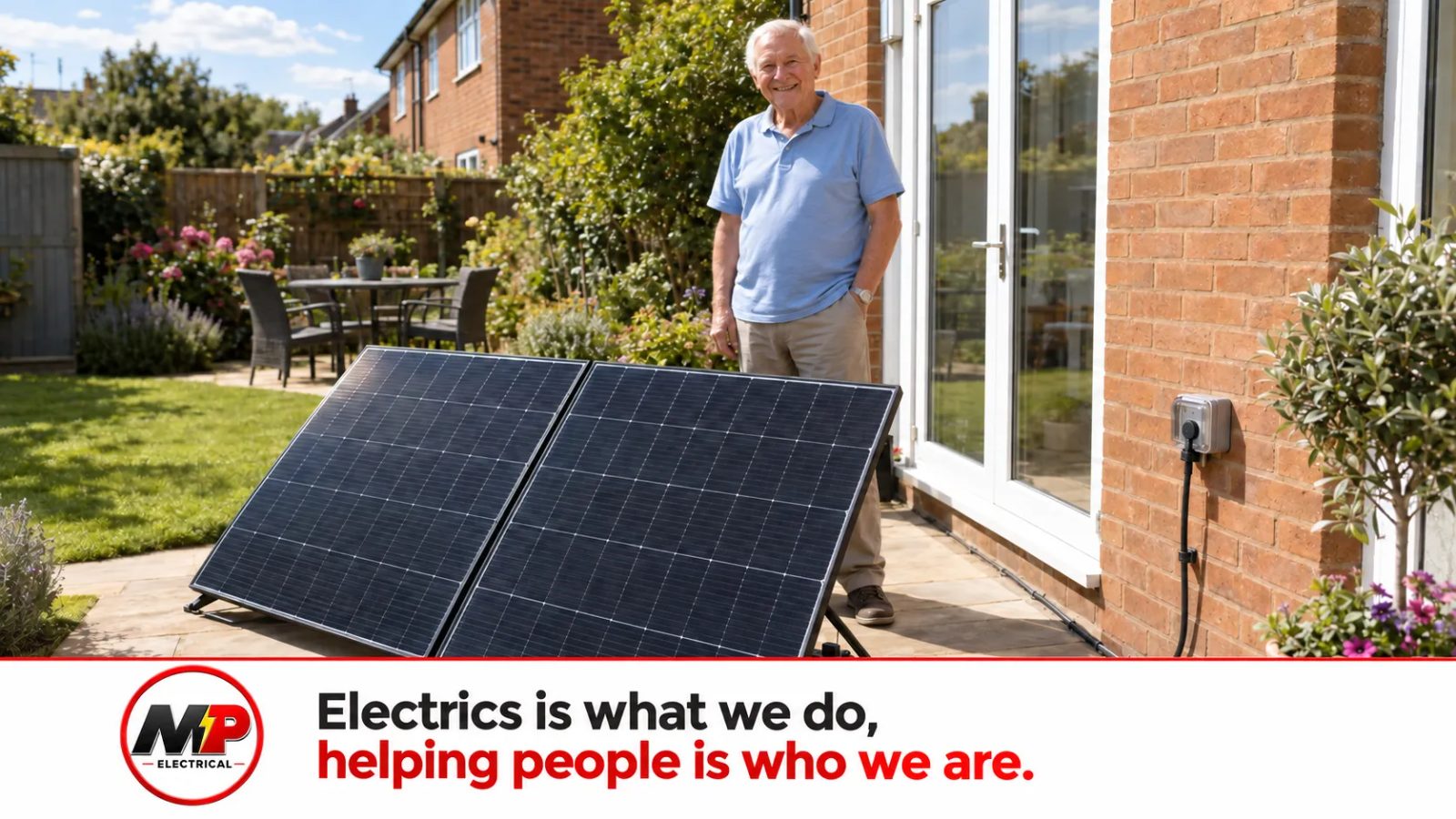
It’s a small solar kit, usually one or two panels, with a little inverter that turns the panel’s electricity into the type your house uses. Instead of being wired into your fuse board, it comes with a moulded 13A plug. You fix the panel to a wall, balcony, flat roof or a frame in the garden, and plug it into a socket.
You’ll also hear them called balcony solar. They’ve been around in Germany for years, where around a million are registered.
The electricity feeds into your house wiring and gets used by whatever is running at the time. Think fridge, freezer, router, TV on standby. That background use is where most of the saving comes from.
What the new rules say
For households in Great Britain, the rules changed through a new law (SI 2026/848) and a government Interim Product Specification. The main points:
- Up to 800W output. The inverter can feed a maximum of 800W into your home, even if the panels behind it are bigger.
- One kit per home. The product spec talks about one per circuit, but the current network rules (called G98) limit it to one per household for now.
- Approved products. Manufacturers have to register each kit on the Energy Networks Association (ENA) Type Test Register before selling it.
- Plug straight into the wall. The spec says extension leads, multi way adaptors, plug in RCD adaptors and travel adaptors are not permitted.
- Socket circuits. Not lighting circuits, and not circuits for fixed equipment like a cooker or shower.
- No batteries. Kits carry a warning not to use them with a battery, and the government says plug in batteries sit outside the current rules.
- Register it. Householders who fit a kit need to notify their network operator, which for homes round here is Northern Powergrid. Which? says to do it within 28 days. The kit’s instructions should include a QR code that takes you to a short online form.
The kit should also come with a label to stick at or near your consumer unit. Please use it. If I open a board and there’s a solar kit feeding the circuit I’m working on, I want to know about it.
One more thing people don’t expect. The inverter switches itself off when the mains goes off, so a plug in kit won’t keep your lights on in a power cut.
How much will it save you?
This is where I’d take the headlines with a pinch of salt.
The government figure is up to £110 a year. That’s based on an 800W kit tilted at 30 degrees, facing south, in a home where someone is in all day. The same government analysis puts a vertical kit facing east or west at around £70.
The Energy Saving Trust says an 800W kit facing south at 30 degrees, with no shade, generates around 700kWh a year. Which?, using the government’s figures, puts savings at £70 to £110 a year, with a payback of roughly 3.6 to 7.1 years.
You might have seen “£1,100” in the news. That’s a lifetime figure over 10 to 15 years, not a yearly saving.
What makes the biggest difference
- Which way it faces. South is best. East or west still works, but gives you noticeably less.
- The angle. A panel hanging flat against a wall produces less than one tilted towards the sun.
- Shade. Trees, next door’s extension or your own guttering can cut output a lot.
- Whether you’re home in the day. The saving comes from using the electricity as it’s made. If the house is empty from eight till six, more of it goes out to the grid.
What happens to the spare electricity?
It flows out to the grid, and in most cases you won’t get paid for it. The Smart Export Guarantee normally needs an MCS certified installation, which plug in kits don’t have. A few energy companies are launching their own offers, so it’s worth asking your supplier.
The safety side: why your electrics matter
I’m not against plug in solar. For the right house, it’s a sensible way to knock a bit off your bills. But the industry bodies have been clear that the condition of your wiring matters.
In June 2026, the IET, Electrical Safety First, NICEIC, ECA and SELECT put out a joint statement raising concerns about power flowing backwards into wiring that wasn’t designed for it, older installations, and people using extension leads. The IET’s advice is to have your installation checked by a competent electrician first.
To be fair, the government’s own safety study tested 800W kits on ring circuits and found nothing that would stop them working safely on properly protected circuits. The key words there are properly protected. A study can’t tell you the state of the wiring in your house.
Your RCDs
An RCD is the safety switch that trips when current leaks to earth. Solar inverters can leak a small amount of DC current, and older Type AC RCDs aren’t designed to cope with that.
Electrical Safety First says homes with Type AC RCDs should upgrade the affected circuit to at least a Type A device that works with power flowing both ways. The type is usually printed on the device or shown as a small symbol. Many older consumer units use Type AC, and if you’re not sure what you’ve got, we can check it for you.
I’ve explained the different types in our guide to RCDs, RCBOs, AFDDs and surge protection.
Old fuse boxes
The product specification itself says that if your home still has older fuse protection without RCBOs, the installation should be checked and, where necessary, upgraded by an electrician. If you’ve still got rewirable fuses, sort that first. Our page on old fuse boxes vs modern consumer units explains why.
The socket itself
The spec also says not to connect a kit to a damaged, degraded or non compliant socket. A scorched or loose socket isn’t the place to start.
Where to plug it in
Most people will want the panel outside and the plug inside, and that’s where I expect to see bodges. A flat cable trapped in a door, or run through a window that can’t shut properly, gets crushed over time and lets the weather in.
The tidy answer is a weatherproof outdoor socket fitted close to where the panel is going, on an RCD protected circuit. Under the spec, the kit’s own outdoor parts have to be rated at least IP55, and I’d want the socket to be at least as good. I’ve covered outdoor sockets in our outdoor socket guide, and the same thinking applies.
Planning, landlords and flats
- Houses in England. New permitted development rules mean you won’t usually need planning permission. Panels on a wall can stick out up to 0.4m, or 0.2m on a wall that sits right on a road or pavement.
- Timber. A kit fixed to a wooden wall, balcony, fence or timber cladding isn’t covered by permitted development, so you’d need planning permission.
- Listed buildings and conservation areas. Permitted development doesn’t cover listed buildings, and conservation areas have extra limits. Check with the council first.
- Renters and leaseholders. The government says you should get permission from your landlord or freeholder before fitting one.
- Blocks having cladding or fire safety work. The product rules say not to fit a kit on a building going through external wall remediation.
- Scotland and Wales. The electrical rules are the same, but planning rules differ, so check locally.
A single panel can weigh up to about 20kg, so fixings matter. Follow the manufacturer’s mounting instructions, and don’t hang one off anything you wouldn’t trust in a storm. It’s also worth telling your home insurer before you fit one.
Plug in solar or full roof solar?
They’re different things. A plug in kit is small, cheap and portable. A full roof system is a proper investment.
The Energy Saving Trust puts a typical 4.5kWp roof system at around £7,600. It generates far more, and because it’s MCS certified you can get paid for the electricity you export. There’s also 0% VAT on installed solar until 31 March 2027.
If you rent, live in a flat, or just want to dip a toe in, plug in solar makes sense. If you own a house with a decent south facing roof, it’s worth weighing up both before you decide.
How MP Electrical can help
You don’t need an electrician to plug a kit in. But plenty of people would rather know their house is ready first, and that’s where we come in. For customers across Rotherham, Wickersley, Bramley, Maltby, Sheffield, Barnsley and Doncaster, we can:
- Check your electrics before you buy. Your consumer unit, RCD types, sockets and earthing, so you know where you stand.
- Tell you which sockets are on which circuit, so you know where the kit can go.
- Upgrade your consumer unit if you’ve got an old fuse box or Type AC RCDs. See our fuseboard replacement page.
- Fit a weatherproof outdoor socket where the panel’s going, so there’s no cable trapped in a door.
- Carry out a full EICR if the wiring is older or you’re not sure what state it’s in. See our EICR page.
- Give you honest advice on whether plug in solar is worth it for your house.
Plug in solar checklist
- Buy a kit listed on the ENA Type Test Register from an established retailer
- Get your consumer unit and RCDs checked, especially with an old board
- Plug directly into a wall socket on a socket circuit, no extension leads or adaptors
- One kit per home
- Stick the supplied label on or near your consumer unit
- Register the kit within 28 days (it goes to Northern Powergrid round here)
- Don’t add a battery
- Get permission first if you rent or are a leaseholder
- Test your RCDs using the test button, as the manufacturer recommends
For more detail, see the government announcement, the ENA Type Test Register and Electrical Safety First’s plug in solar advice.
Frequently asked questions
Can households use plug in solar panels in the UK?
Yes, in England, Scotland and Wales since 27 August 2026. Northern Ireland isn’t covered yet.
Do I need an electrician to install plug in solar?
Not to plug it in. But the IET and Electrical Safety First both advise getting your electrics checked first, and the product instructions tell people with older fuse protection to get the installation checked by an electrician.
Can I have two plug in solar kits?
Not at the moment. The current network rules limit it to one kit per household.
Will plug in solar work in a power cut?
No. The inverter is designed to switch off when the mains supply goes, which protects anyone working on the network. It is the same reason roof solar stops working in a power cut.
Can I add a battery to my plug in solar kit?
Not under the current rules. Kits carry a warning not to use them with a battery, and plug in batteries sit outside the new framework.
Contact MP Electrical
If you need help getting your home ready for plug in solar, or with any electrical work in Rotherham or South Yorkshire, MP Electrical are happy to help.
📞 Call our office on 01709 645115
🌐 Visit: https://www.rotherhamelectrician.co.uk
We’re a trusted local electrician with over 330 five star Google reviews, and we’re happy to give helpful advice. You’ll get a clear, no pressure quotation, and booking online is easy, with text and email confirmations so you know exactly when we’re coming. If you want to see what we do first, take a look at our recent work.
Written by Mat at MP Electrical
NAPIT-registered electrician serving Rotherham & South Yorkshire. 330+ five-star reviews.
Last updated: 12 October 2026
You Might Also Like
Outdoor Sockets for Christmas Lights: A Rotherham Electrician's Guide
Every year, around the middle of November, the same picture starts appearing on streets across...
16 Sep 2026LED Lights Flickering on a Dimmer? Why It Happens and How to Fix It
You've swapped the old halogen bulbs for LEDs. Then you turn the dimmer down and...
16 Sep 2026Do Solar Panels Still Work in a Power Cut?
Do Solar Panels Still Work in a Power Cut? Do Solar Panels Still Work in...
8 Apr 2026Most read on this site
The pages people open most often when they land here.
- Why do my electrics keep tripping?
- EV charger installation in Rotherham
- Fitting an EV charger with no driveway
- Why a cracked plug socket is worth sorting
- Can your home electrics handle an EV charger?
- What electrical work you can legally do yourself
- What happens during an EV charger installation
- CCTV installation in Rotherham
Need an Electrician in Rotherham?
NAPIT registered with five star Google reviews
For straightforward jobs we can often quote over the phone or from photos.
