
RCD vs RCBO, AFDD and Surge Protection Explained in Plain English
The lights have gone off and you’re staring at a row of switches under the stairs with letters that mean nothing to you. RCD. RCBO. SPD. Maybe AFDD.
Then an EICR or a consumer unit quote lands, and the same letters turn up again.
I’m Mat from MP Electrical, an electrician for over 25 years, and this is the plain English guide I’d hand any homeowner in Rotherham.
Quick answer
An RCD protects people from electric shock by switching off when current leaks to earth, but one RCD usually covers several circuits at once. An RCBO does the same job plus overload protection, for one circuit only, so a fault only switches off that circuit. An AFDD detects dangerous arcing that can start fires, and an SPD (surge protection device) helps protect your wiring and electronics from voltage spikes.
Start with the basics: fuses and MCBs
A rewireable fuse or an MCB (miniature circuit breaker) protects the cable, not you. It switches off when too much current flows, from an overload (too much plugged in) or a short circuit.
What an MCB doesn’t do is notice a small amount of current leaking through a person to earth. A current far too small to trip a 32 amp breaker can still be enough to kill. That’s where the RCD comes in.
What is an RCD?
An RCD (residual current device) compares the current going out on the live with the current coming back on the neutral. If they don’t match, some is leaking somewhere, possibly through someone’s body.
In homes, the usual rating is 30mA. When the imbalance reaches that sort of level, the RCD is designed to switch off in a fraction of a second, fast enough to greatly reduce the risk of a fatal shock.
The test button
An RCD has a test button, usually marked “T”. Pressing it creates a small deliberate imbalance so you can check the mechanism still trips.
The IET’s guidance, based on BS 7671, is that homeowners should press the test button every six months, and plenty of manufacturers print similar advice on the device itself. A handy reminder is to do it when the clocks change.
A few tips:
- Warn the household first, as those circuits will go off.
- If it doesn’t trip or won’t reset, get a local electrician to look at it.
The problem with split load boards
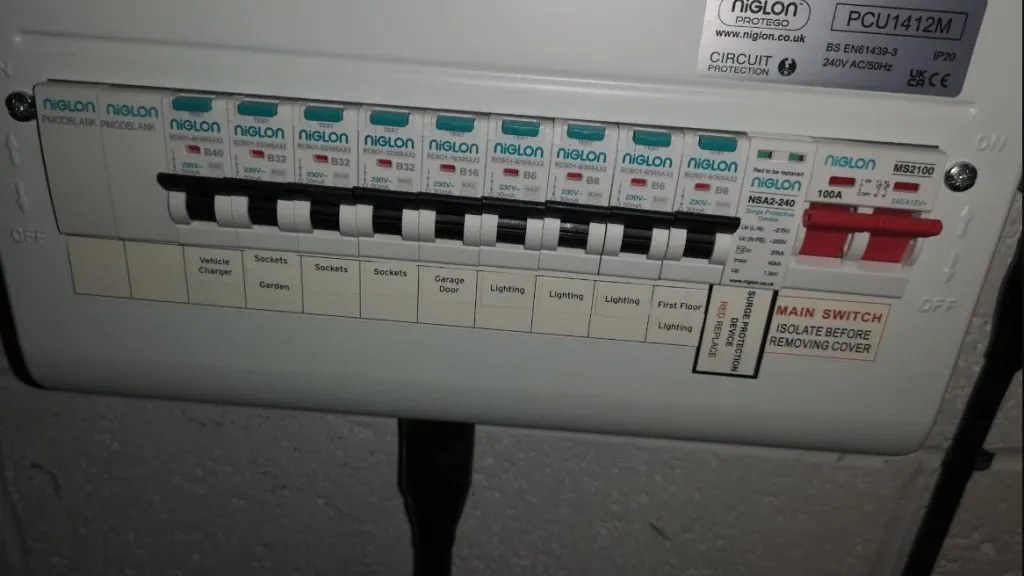
Lots of houses around Rotherham, Wickersley and Bramley have a split load board: one or two main RCDs, each protecting a whole bank of circuits.
The snag? If the washing machine develops a fault, the RCD can switch off your kitchen sockets, fridge freezer, upstairs lights and boiler controls, all at once.
A common call I get is “half the house has gone off and I can’t get it back on.” More often than not it’s a split load board and one faulty appliance or circuit taking out everything else with it. Finding the culprit takes proper fault finding, because the RCD itself doesn’t tell you which circuit caused it.
What is an RCBO?
An RCBO is an MCB and an RCD combined in one device. It protects against overload, short circuit and earth leakage, but for one circuit only.
So, RCD vs RCBO in one sentence: an RCD protects a group of circuits against leakage, while an RCBO gives each circuit its own complete protection.
Why does that matter in real life?
- If the kettle trips its circuit, your freezer stays on.
- If the outside lights get damp, the upstairs lights don’t go off with them.
- Small leakages from lots of appliances don’t add up on one shared RCD, so fewer nuisance trips.
That’s why our consumer unit upgrades use individual RCBO protection on each circuit.
What is an AFDD?
An AFDD (arc fault detection device) is the newest device you’re likely to see on a fuseboard.
What is an arc fault?
An arc is electricity jumping across a gap. It can happen when:
- a cable has been crushed behind furniture or pierced by a nail or screw
- a connection in a socket or junction box has worked loose
- old cable insulation has broken down
A series arc like this might not draw enough current to trip an MCB, and if nothing is leaking to earth an RCD won’t see it either. Yet it can get hot enough to start a fire inside a wall or behind a sofa.
An AFDD watches the pattern of the current for the tell tale signature of arcing and switches off the circuit when it spots it. Many AFDDs are combined units that also include RCBO protection.
What does BS 7671 say about AFDDs?
The current wiring regulations are BS 7671:2018 with Amendment 4 (2026), published by the IET and BSI in April 2026. The previous version with Amendment 3 is due to be withdrawn in October 2026.
Amendment 4 didn’t widen the AFDD rules. For new work, designers and installers are required to fit AFDDs on socket circuits up to 32 amps in certain higher risk buildings, such as high rise residential blocks, purpose built student accommodation and care homes.
For ordinary houses, like the semis and terraces we work on around Maltby and Rotherham, BS 7671 recommends AFDDs rather than requiring them. For homeowners it’s a choice, and a good electrician should explain it honestly.
I’d give them serious thought with older wiring, bedrooms full of chargers, or where someone might struggle to get out quickly in a fire.
What is surge protection (SPD)?
A surge is a very short spike in voltage that can damage sensitive electronics or wear them out over time.
According to the IET, surges come from two main places:
- Switching: motors, transformers and some lighting, plus things like heat pumps and EV chargers.
- Lightning: usually an indirect strike, for example on a nearby overhead line, rather than a direct hit on your house.
An SPD sits in the consumer unit and diverts that spike to earth before it reaches your TV, boiler controls or router.
When do electricians have to fit an SPD?
For new work, BS 7671 requires electricians to provide surge protection in single dwellings unless the value of the installation and equipment doesn’t justify it.
With the amount of electronics in homes around Sheffield, Barnsley and Doncaster these days, it’s usually hard to argue it isn’t worth it. You can read the IET’s consumer guide to surge protection if you’d like more detail.
Comparison table
| Device | Protects against | Protects | Covers | Test button |
|---|---|---|---|---|
| Fuse or MCB | Overload and short circuit | The cable | One circuit | No |
| RCD | Earth leakage (shock) | People | Usually several circuits | Yes |
| RCBO | Overload, short circuit and earth leakage | Cable and people | One circuit | Yes |
| AFDD | Arcing faults (fire) | Property and people | One circuit | Usually |
| SPD | Voltage surges | Wiring and electronics | Whole installation | No, often has a status indicator |
RCD type matters even more now that plug in solar is legal. Those inverters can leak a small amount of DC current, so a Type AC device is not suitable. Our plug in solar guide explains what to check before buying a kit.
How these devices show up on an EICR
An EICR (Electrical Installation Condition Report) checks the installation against the current BS 7671, including what protection is present and how it performs.
Observations are given codes:
- C1: danger present, immediate action needed
- C2: potentially dangerous, urgent action needed
- C3: improvement recommended
- FI: further investigation needed
Missing RCD protection, an RCD that fails its trip test or no surge protection can each be recorded, but coding depends on the installation and what the inspector finds. It isn’t possible to say in advance how your own property will come out.
Rules change over time, and an older board isn’t automatically dangerous just because it doesn’t match the latest amendment.
If you’re a landlord, private landlords in England must have the electrics in their rented homes inspected and tested at least every five years under the GOV.UK electrical safety standards guidance. Owner occupiers have no legal duty to get an EICR, though it’s sensible when you move in or if the wiring is getting on a bit. Our EICR testing page explains how we go about it.
What to expect on a consumer unit quote
When we quote for a consumer unit upgrade in Rotherham, here’s what you can expect us to talk you through:
- A metal consumer unit, as BS 7671 expects electricians to use a non combustible enclosure in homes, and metal is the usual way to meet that.
- Individual RCBOs for each circuit, rather than a split load arrangement.
- Surge protection, for the reasons above.
- AFDDs as an option, explained honestly, so you can decide.
- Testing of each circuit, because a new board can reveal faults the old one was hiding.
- Notification and certification, as replacing a consumer unit is notifiable work for homeowners in England under Part P, which we handle as a registered electrician.
We also fit a small fire extinguisher inside every consumer unit we install as standard, for extra peace of mind.
Every job is quoted properly after we’ve had a look, and it’s free to ask. If you want to see some finished boards, have a look at our recent work.
Related reading: earthing and bonding explained and our EV charger installation page.
Frequently asked questions
Is an RCBO better than an RCD?
For most homes, yes. Both give the same shock protection, but an RCBO only switches off the one circuit with the fault, so the rest of the house stays on.
Do I legally need AFDDs in my house?
Owner occupiers of ordinary houses have no legal requirement to fit AFDDs. BS 7671 recommends them for socket circuits in most homes, and requires installers to fit them in certain higher risk building types, such as high rise flats and care homes.
How often should I press the RCD test button?
The IET guidance is every six months. Changing the clocks is an easy reminder.
Why does my RCD keep tripping?
Often it’s a faulty appliance, moisture in an outside light or socket, or damaged cable. If unplugging appliances doesn’t sort it, call a local electrician.
Related services and guides
- Consumer unit and fuseboard upgrades
- EICR testing in Rotherham
- Why do my electrics keep tripping?
- Is your consumer unit up to regulations?
- Earthing and bonding explained
- Electric showers: what a proper install involves
Contact MP Electrical
If you need help with RCDs, RCBOs, surge protection or any electrical work in Rotherham or South Yorkshire, MP Electrical are happy to help.
📞 Call our office on 01709 645115
🌐 Visit: rotherhamelectrician.co.uk
📅 Book online: Book your appointment online
We’re a trusted local electrician with over 320 five star Google reviews, and we’re happy to give helpful advice, even if you’re just trying to work out what’s on your fuseboard. Quotations come with no pressure, booking online is easy, and you’ll get text and email confirmations so you know exactly when we’re coming.
Written by Mat at MP Electrical
NAPIT-registered electrician serving Rotherham & South Yorkshire. 330+ five-star reviews.
Last updated: 22 September 2026
You Might Also Like
What Is Nuisance Tripping and Why Does It Keep Happening? | MP Electrical
What Is Nuisance Tripping? Nuisance tripping is when your RCD (residual current device) or MCB...
3 Aug 2026Green Goo in Your Fuseboard: What It Means and Why It Is Dangerous | MP Electrical
What Is Green Goo in a Consumer Unit? If an electrician has ever opened your...
3 Aug 2026Bathroom Electrics: Zones, Rules and What You Need to Know
Bathrooms are one of the highest-risk rooms in your home when it comes to electrical...
29 Jun 2026Most read on this site
The pages people open most often when they land here.
- Why do my electrics keep tripping?
- EV charger installation in Rotherham
- Fitting an EV charger with no driveway
- Why a cracked plug socket is worth sorting
- Can your home electrics handle an EV charger?
- What electrical work you can legally do yourself
- What happens during an EV charger installation
- CCTV installation in Rotherham
Need an Electrician in Rotherham?
NAPIT registered with five star Google reviews
For straightforward jobs we can often quote over the phone or from photos.
