
Warm, Buzzing or Discoloured Sockets and Switches: What’s Normal and What Isn’t
Most people never think about their sockets and switches until something feels off. You go to unplug the heater and the plug’s warmer than you expected. You hear a faint buzz from the light switch in the hallway. Or you finally move the sofa and find a socket that’s gone a funny brown colour.
I’m Mat from MP Electrical, an electrician for over 25 years, covering Rotherham and South Yorkshire. Here’s how to tell the difference between “that’s fine” and “get that looked at”.
Quick answer
A plug that feels slightly warm after a heater or tumble dryer has been running for a while can be normal. A socket faceplate or switch that feels warm or hot, any brown, yellow or black marks, or a buzzing, crackling or fizzing sound are warning signs. Switch off, stop using it and get an electrician to check it.
Warm plugs and sockets
When a bit of warmth can be normal
High power appliances pull a lot of current. Things like:
- Plug in heaters
- Tumble dryers
- Kettles
- Washing machines on a hot wash
- Hairdryers
After a long run, the plug on one of these can feel slightly warm. That on its own isn’t automatically a fault.
When warmth isn’t normal
Fire services are clear on this: plugs or sockets that are hot to the touch are a danger sign. In particular, take it seriously if:
- The socket faceplate itself is warm, not just the plug
- The plug is too hot to hold comfortably
- It gets warm with a small load, like a phone charger or lamp
- One socket is warm and others with similar loads aren’t
- There’s a smell of hot plastic, or a fishy smell
- The plug feels loose in the socket
If the plug is hot or the socket looks damaged, switch the circuit off at the fuseboard rather than grabbing the plug.
Why do sockets get warm?
Loose connections
This is the big one. Inside a socket, the wires are held in terminals, usually by small screws. Over time, those connections can work loose, particularly on sockets that get plugged in and out a lot or have been knocked.
A loose connection means resistance, and resistance means heat. The more current flows, the hotter it gets. Over months or years that heat can scorch the plastic and, in the worst cases, start a fire.
Worn socket contacts
The metal contacts that grip the plug pins lose their grip with age and use. The plug sits loose, makes a poor contact and heats up. If your plugs fall out or droop out of a socket, that socket is worn.
Overloading
Washing machines and tumble dryers should have a socket to themselves, and the general advice from fire services is one socket, one plug for anything heavy.
Plugging a heater and a kettle into a double adaptor, or running several big appliances off one extension lead, can overheat the plug, lead and socket. This is a common one in winter.
Cheap or damaged plugs
Badly made plugs, counterfeit chargers and plugs with damaged pins all make poor contact. If a plug is getting hot, try the appliance in another socket. If the plug still heats up, the problem may be the plug or the appliance.
Discoloured sockets and switches
White plastic yellows with age and sunlight, and that’s just cosmetic. What I’m more interested in is:
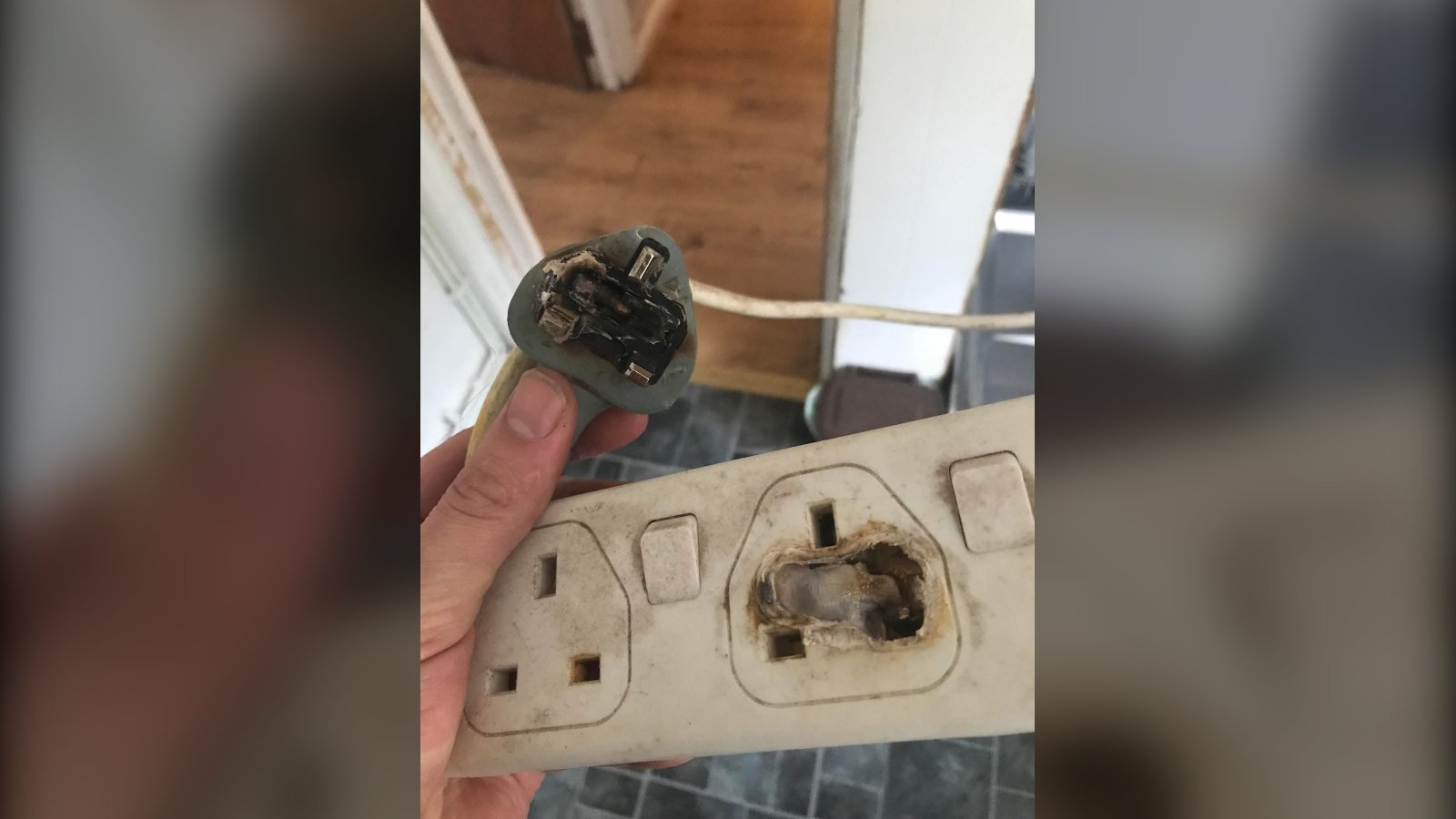
- Brown or black marks around the pin holes
- Scorching on the edge of the faceplate or behind it
- A plug top that’s discoloured on one pin
- Melted or warped plastic
Those marks are a sign of heat, and heat means something’s wrong behind the faceplate. Don’t just paint over it or swap the plug. The cause is usually inside the socket, not on the front of it.
If the socket is cracked as well, read why you shouldn’t ignore a cracked plug socket.
Buzzing sockets and switches
A buzzing light switch
One of the most common causes of a buzzing light switch is a dimmer switch running LED bulbs. Older dimmers were designed for traditional bulbs, and LEDs don’t always get on with them. You can get buzzing, flickering or lights that won’t dim properly.
That’s usually a compatibility issue rather than a danger, and the fix is normally an LED compatible dimmer or different bulbs. I explain it properly in why LED lights flicker on dimmer switches.
Buzzing, crackling or fizzing from a socket
This is different. Fire services list buzzing or crackling from plugs and sockets as a warning sign of arcing, which is electricity jumping across a gap. That can happen at a loose terminal or a damaged contact, and it creates intense heat.
If a socket is buzzing, crackling or fizzing:
- Stop using it.
- Switch the circuit off at the fuseboard.
- Get it checked.
A humming fuseboard
A faint hum from some fuseboard devices can be normal, but a loud buzz, crackle or a hum that’s new or getting louder needs looking at. If there’s heat, smell or crackling, treat it as urgent.
What to do if you’ve found a warm or buzzing socket
- Switch off and unplug if it’s safe to touch.
- If the plug or socket is hot, damaged or crackling, switch off the circuit at the fuseboard instead.
- Don’t use that socket until it’s been checked.
- Try the appliance in another socket to see if the problem follows it.
- Call an electrician.
If there’s smoke, sparks or flames, get everyone out and call 999. My guide on a burning smell from a socket or fuseboard covers that situation step by step.
What I do when I come out
For a warm, buzzing or discoloured socket or switch, I’ll:
- Isolate the circuit
- Take the faceplate off and check the terminals and cables behind it
- Look for heat damage to the cable insulation, not just the socket
- Replace the socket or switch with a good quality one
- Tighten and check the other connections on the circuit where needed
- Test the circuit before putting it back on
If one socket has been overheating, it’s worth checking the others on the same circuit. If several are in a bad way, or there are signs of older wiring, I’ll explain whether an EICR would be sensible. You can find out more on our EICR page.
Worth doing while you’re at it
Swapping a worn or discoloured socket is a small job, so it’s often worth combining it with other bits:
- Replacing other tired sockets and switches
- Adding sockets to cut down on extension leads
- USB sockets by the bed or in the kitchen
- Outside sockets for the garden or Christmas lights, see my outdoor socket guide
Frequently asked questions
Is it normal for a plug socket to feel warm?
A plug can feel slightly warm after a high power appliance has been running for a while. A socket faceplate that’s warm, or anything hot to the touch, isn’t normal and should be checked.
Why is my light switch buzzing?
Usually it’s a dimmer that isn’t compatible with LED bulbs. If it’s not a dimmer, or there’s heat, a smell or crackling, get it checked.
Can a warm socket cause a fire?
Yes. Overheating at loose connections is a known cause of electrical fires, which is why fire services list hot sockets as a warning sign.
Can I just replace the socket myself?
Replacing a like for like socket is minor work, but if it’s been overheating, the cable behind it may be damaged too. That needs testing, not just a new faceplate.
Get it checked
If you’ve got a warm, buzzing or marked socket or switch anywhere in Rotherham, Wickersley, Bramley, Maltby, Sheffield, Barnsley or Doncaster, get in touch. Have a look at our fault finding page for how we track down problems like this.
Contact MP Electrical
If you need help with any electrical work in Rotherham or South Yorkshire, MP Electrical are happy to help.
📞 Call our office on 01709 645115
🌐 Visit: https://www.rotherhamelectrician.co.uk
We’re a trusted local electrician with over 350 five star Google reviews, and we’re happy to take on small jobs as well as big ones, whether it’s one socket or a whole house. Quotations come with no pressure, booking online is easy, and you’ll get text and email confirmations so you know exactly when we’re coming.
Written by Mat at MP Electrical
NAPIT-registered electrician serving Rotherham & South Yorkshire. 350+ five-star reviews.
Last updated: 20 November 2026
You Might Also Like
Electrician Who Does the Small Jobs Near Me: MP Electrical in Rotherham
Electrician Who Does the Small Jobs Near Me: MP Electrical in Rotherham If you’ve ever...
8 Apr 2026Immersion Heater Not Working? Storage Heater Faults Explained by a Rotherham Electrician
You go to run a bath and the water is barely lukewarm. Or the storage...
16 Sep 2026Common Small Electrical Jobs That Make a Big Difference | MP Electrical
Not every electrical job involves ripping out walls or rewiring the house. Some of the...
30 Jul 2026Most read on this site
The pages people open most often when they land here.
- Why do my electrics keep tripping?
- EV charger installation in Rotherham
- Fitting an EV charger with no driveway
- Why a cracked plug socket is worth sorting
- Can your home electrics handle an EV charger?
- What electrical work you can legally do yourself
- What happens during an EV charger installation
- CCTV installation in Rotherham
Need an Electrician in Rotherham?
NAPIT registered with five star Google reviews
For straightforward jobs we can often quote over the phone or from photos.
